

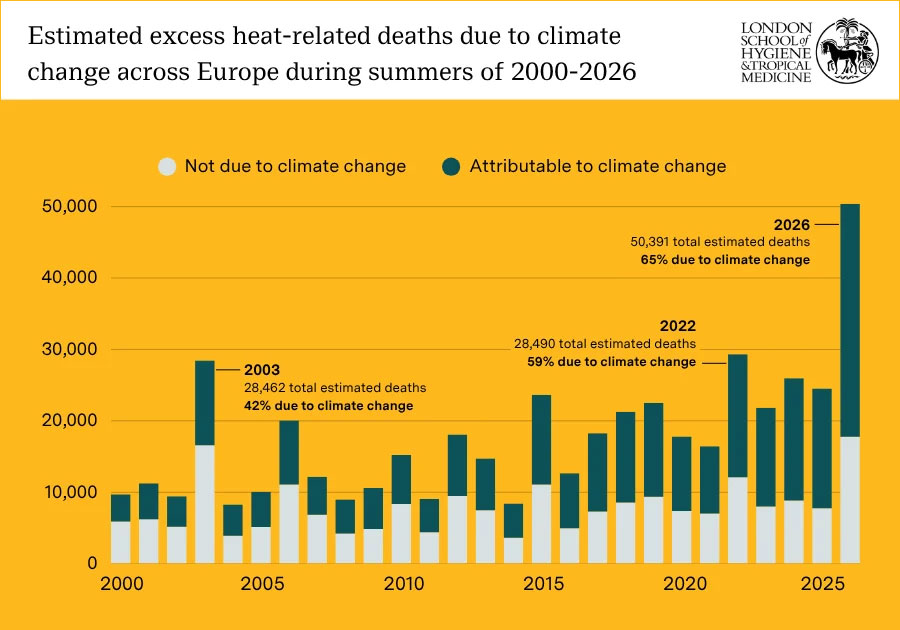
More than 50,000 heat-related deaths are estimated to have occurred in urban areas across Europe during summer 2026, with around two-thirds attributed to human-induced climate change, according to new research led by the London School of Hygiene & Tropical Medicine (LSHTM) and Imperial College London.
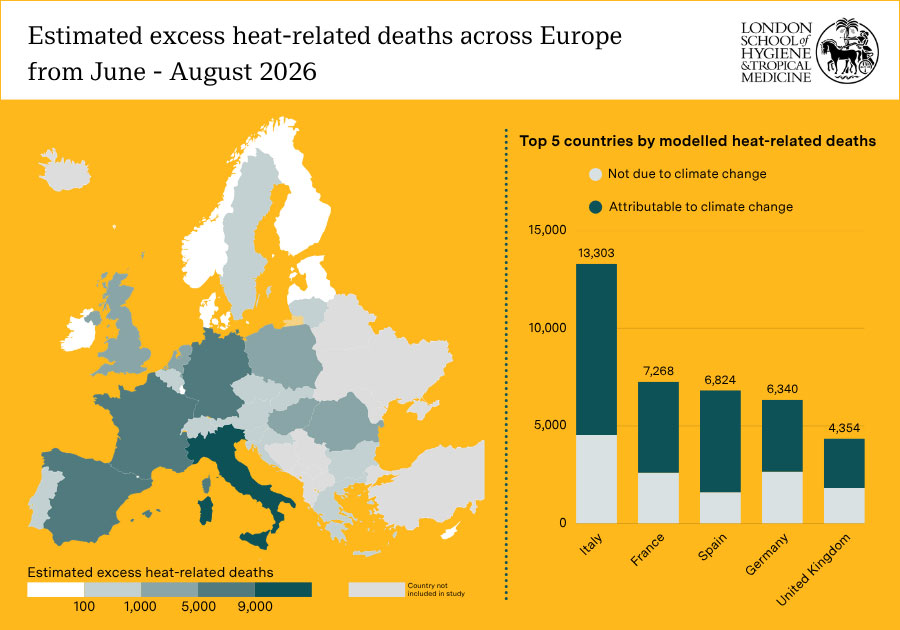
The study, published in Nature Health, analysed temperatures and estimated heat-related mortality in 854 urban areas across 27 EU countries, the UK, Norway and Switzerland. Together, these areas account for approximately 40% of the population of the 30 countries included.
The researchers found that summer 2026 had the highest heat-related death toll in since 2000 – almost double that of the summer of 2022, when around 29,000 deaths were attributed to heat, and 2003, when the toll was approximately 28,000.
Nearly one-third of the deaths estimated for summer 2026 occurred between 17 June and 1 July, when average daily temperatures across the region were more than 5°C above the 1991–2020 average.
Southern and western Europe experienced the highest temperatures and estimated mortality rates. Western Europe experienced the largest temperature anomaly, with average temperatures approximately 2.9°C above the 1991–2020 average. On some days, temperatures were as much as 12°C above the seasonal average.
→ This story is based in part on an original press release from the Grantham Institute – Climate Change and the Environment at Imperial College London.